The Rise of AI
Throughout human history, major technological shifts have altered the course of civilization, from the mechanical muscle of the Industrial Revolution to the digital connectivity of the internet age. Today, we are standing on the precipice of a transformation that promises to be infinitely more profound: the ascension of artificial intelligence. What began as a series of narrow mathematical experiments in the mid-20th century has rapidly evolved into an omnipresent computational force capable of writing code, composing art, diagnosing complex medical conditions, and mimicking human conversation. The Rise of AI represents a monumental shift where software is transitioning from a passive tool we command to an active partner that operates with an unprecedented degree of autonomy, forever altering the fabric of our future.
To understand the sudden, meteoric acceleration of artificial intelligence, one must look at the convergence of three foundational pillars: the birth of advanced deep-learning neural networks, a massive explosion in global data harvesting, and the arrival of high-performance silicon chips. For decades, computer scientists attempted to hardcode human logic into machines using strict "if-then" rule sets, a rigid paradigm that failed when faced with the messy nuance of real-world variables. The modern breakthrough came from flipping this script; by building multi-layered digital neural networks inspired by the human brain, engineers allowed machines to learn on their own. Fed on massive petabyte-scale datasets, these models analyze billions of parameters to independently map hidden statistical correlations, allowing them to comprehend context and execute tasks with fluid, human-like adaptability.
This technological leap has propelled the industry past the era of Narrow AI—systems trained strictly to perform a single isolated function, like recommending a song or filtering email spam—and thrust us into the age of generative models and multi-modal systems. Today's cognitive platforms do not merely categorize information; they synthesize completely original content. By processing text, audio, images, and video simultaneously, these advanced networks possess an integrated, multi-sensory understanding of our reality. They are swiftly integrating into professional work environments, automating complex administrative tasks, generating software code in seconds, and optimizing intricate global logistics chains, leading to a massive spike in human operational efficiency while challenging our traditional definitions of cognitive labor.
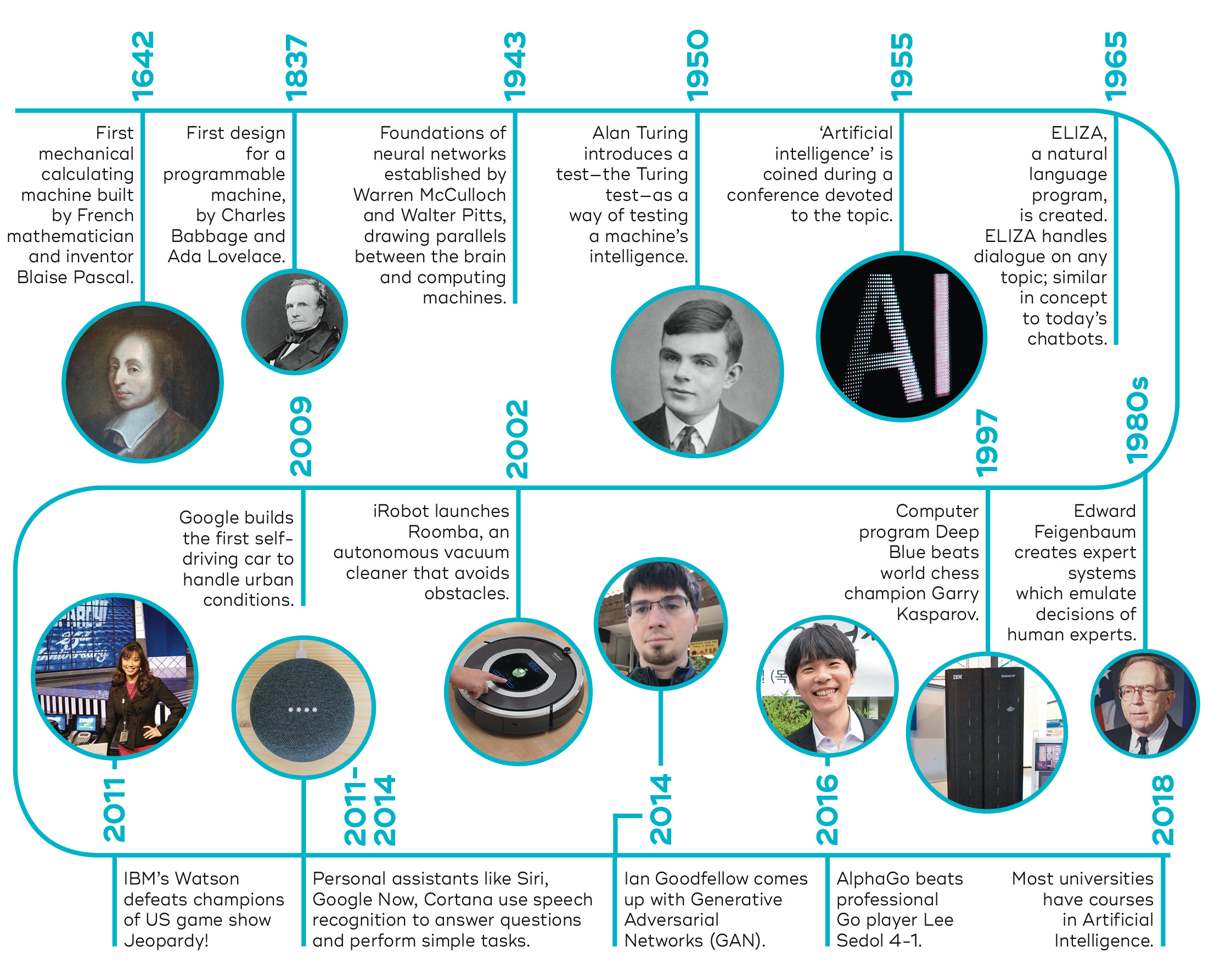
As this momentum builds, the critical question shifting to the forefront of global conversation is what the future holds for human society. In the short term, the landscape will be defined by a massive restructuring of the workforce. While historical automation targeted repetitive manual labor, AI is moving directly into cognitive white-collar domains. Legal analysis, financial forecasting, journalism, and creative design are all experiencing severe disruptions. This shift does not necessarily signal the end of human work, but rather a profound evolution. The workers of tomorrow will likely transition away from raw execution and move into roles centered around curation, prompt engineering, and ethical oversight, using AI as a cognitive bicycle to radically amplify their personal creative output.
Looking further into the horizon, the ultimate and most controversial milestone of this trajectory is the theoretical arrival of Artificial General Intelligence (AGI)—software that matches or exceeds human cognitive capacities across every single economically valuable domain. If achieved, AGI would possess the unique capability to recursively improve its own underlying code, triggering an exponential intelligence explosion that could solve ancient human mysteries in fractions of a second. This future presents an incredible utopian vision where autonomous systems could successfully design zero-emission energy grids, discover cures for terminal chronic illnesses, orchestrate hyper-efficient resource distribution, and pioneer advanced deep-space exploration far beyond our current technological capabilities.
However, this breathtaking potential is accompanied by existential societal risks that humanity must actively manage. The rapid proliferation of hyper-realistic deepfakes and automated misinformation campaigns threatens to permanently corrode our shared public trust in digital media. Furthermore, the massive computing infrastructure required to train and run these monolithic models demands an immense amount of electrical power and water cooling, placing a heavy ecological strain on global resources. Most critically, the "black box" nature of deep learning—where the internal decision-making pathways of a model are too complex for human engineers to fully audit—presents a profound alignment challenge, making it vital that we establish rigorous international guardrails to ensure these systems remain fundamentally safe and beneficial to humanity.
Ultimately, the rise of artificial intelligence is not a distant wave on the horizon; it is an active current reshaping our present world. It forces us to confront deep philosophical questions about the nature of mind, creativity, consciousness, and what truly makes us unique as a species. The future of this technology will not be a static destiny that simply happens to us, but a reflection of the choices, values, and guardrails we implement today. By guiding this immense computational power with empathy, wisdom, and rigorous scientific ethics, humanity can ensure that the rise of the machine becomes the catalyst for our greatest era of collective enlightenment and discovery.