Animal Intelligence: Bridging the Evolutionary Gap
For centuries, human exceptionalism positioned our species on an isolated intellectual island, operating under the assumption that advanced logic, complex language, and sophisticated tool usage were exclusively human traits. However, modern ethology and cognitive biology have thoroughly shattered this paradigm, revealing that our closest living relatives—the great apes—possess deep cognitive worlds that mirror our own in startling ways. By studying the communication networks of chimpanzees and bonobos alongside the brilliant physical problem-solving and observational learning skills of orangutans, scientists are discovering that the gap between human and animal intelligence is a continuum rather than a chasm. These discoveries force us to redefine the very nature of consciousness and mind.
When examining communication skills, chimpanzees (Pan troglodytes) and bonobos (Pan paniscus) offer a fascinating look into the evolutionary origins of human language. Because great apes lack the specialized vocal tract morphology required to produce articulate human speech, researchers in long-term sanctuary environments utilized American Sign Language (ASL) and specialized lexigram boards to bridge the gap. Iconic primates like the bonobo Kanzi famously demonstrated an advanced mastery of lexigram symbols, proving an ability to comprehend complex syntax, express novel desires, and even understand spoken English sentences. Rather than just responding to mechanical training prompts, Kanzi showed true semantic intent, combining abstract symbols to create entirely new meanings and proving that the cognitive hardware for language processing predates the evolution of human speech.
Beyond controlled laboratory settings, wild chimpanzee populations showcase a highly sophisticated vocabulary of natural gestures and vocalizations that serve as an active linguistic network. Field researchers have meticulously cataloged dozens of distinct, intentional gestures—ranging from urgent hand-shoves to specific arm shakes—used by chimps to negotiate complex social hierarchies, coordinate hunting parties, and express empathy within their communities. Bonobos take this communicative flexibility a step further, utilizing a diverse suite of high-frequency "peep" vocalizations. Remarkably, the meaning of these peeps shifts entirely depending on the social context, a linguistic property known as functional flexibility that was long believed to be a unique hallmark of human conversation and emotional expression.
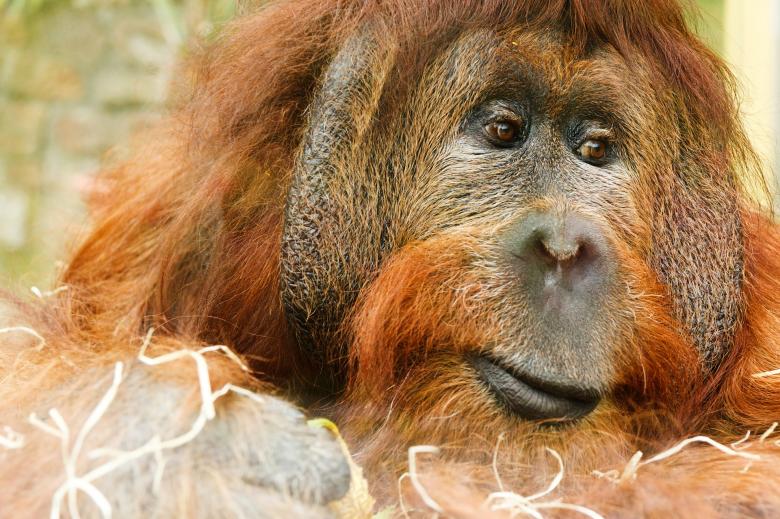
While chimpanzees and bonobos excel in the social and communicative arenas, the solitary orangutan (Pongo) represents the pinnacle of primate physical intelligence and spatial engineering. Inhabiting the dense, highly challenging forest canopies of Borneo and Sumatra, orangutans possess a deep mechanical understanding of their environment. Unlike any other non-human animal, they display an innate grasp of structural engineering, meticulously selecting branches with specific diameters and elastic properties to build secure, daily sleeping platforms high in the trees. They actively calculate load-bearing capacities and weave complex nodes, demonstrating a forward-thinking cognitive blueprint and an awareness of physical mechanics that rivals human structural planning.
The true genius of the orangutan, however, lies in its peerless capacity for observational learning and tool innovation. In the wild, orangutans custom-modify linear tree branches to fish for nutritious termites or extract seeds from protective, needle-covered husks, reshaping their tools based on the specific mechanical problem at hand. In rehabilitation sanctuaries, their capacity for mimetic learning borders on the uncanny. By closely watching human caretakers, orangutans have autonomously learned to use hammers to drive nails, manipulate manual hand-saws to cut wood, and use soap to wash clothes. This is not simple, robotic mimicry; it is an analytical process where the ape breaks down a multi-step human action, maps the physical cause-and-effect relationship, and accurately replicates the sequence to achieve a targeted goal.
The profound significance of these overlapping intelligences completely upends our understanding of evolutionary history. The remarkable linguistic capabilities of the genus Pan combined with the fluid, technical problem-solving of Pongo indicate that the foundational building blocks of the human mind—symbolic thought, engineering logic, cultural transmission, and empathy—were already deeply embedded in our common lineage millions of years ago. Human intelligence did not suddenly emerge out of a vacuum; instead, our evolutionary path simply supercharged an existing, highly sophisticated primate toolkit, utilizing language and advanced culture to scale these latent capabilities to global proportions.
Ultimately, looking into the expressive eyes of an articulate bonobo or watching a focused orangutan manufacture a custom tool forces a profound ethical and philosophical reckoning. It reminds us that humanity is not the sole author of complex thought on Earth, but rather a single branch on a diverse tree of terrestrial consciousness. As habitat destruction, industrial logging, and climate change push these magnificent great apes dangerously close to the brink of extinction, protecting them is no longer just an environmental duty—it is a quest to preserve the living mirrors that reflect the deepest origins of our own humanity.