Messiah 87 Pōwehi Black Hole
On April 10, 2019, humanity achieved what was long considered scientifically impossible: capturing the first direct visual evidence of a black hole. Located 55 million light-years away from Earth at the center of the supergiant elliptical galaxy Messier 87 (M87), this cosmic titan was formally bestowed the traditional Hawaiian name Pōwehi, meaning the "adorned fathomless dark creation". This historical breakthrough did not come from a single eyepiece, but from the Event Horizon Telescope (EHT) collaboration—a revolutionary planetary network linking eight ground-based radio observatories across the globe to effectively transform Earth into one massive, synchronized telescope.
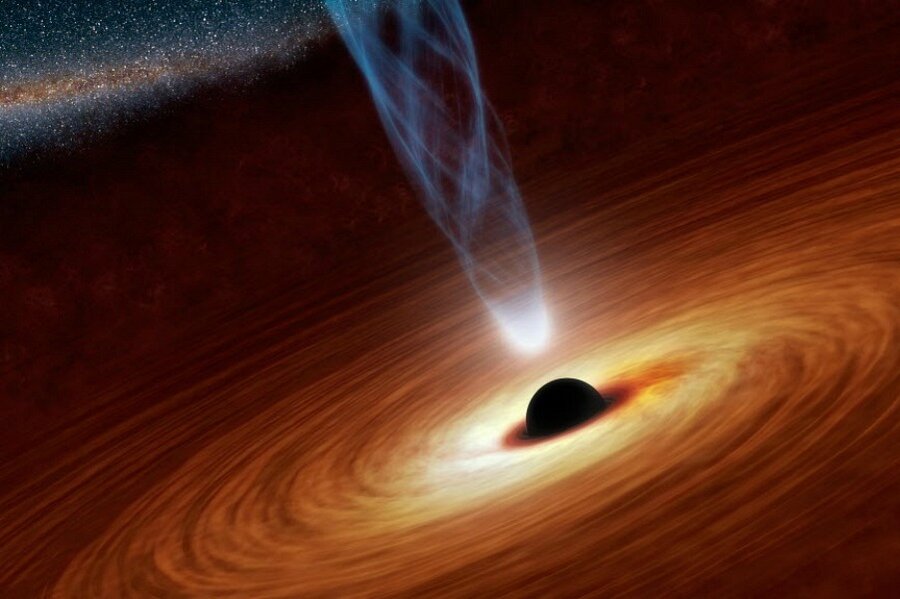
The resulting historic image revealed a vibrant, asymmetric ring of light encircling a profound, circular darkness. This dark core is the "shadow" of the black hole, a boundary demarcating the event horizon where gravity is so overwhelmingly immense that not even light can achieve the velocity required to escape its grasp. The brilliant orange ring consists of superheated, incandescent gas and plasma screaming around the void at relativistic speeds close to the speed of light. Its glowing asymmetry serves as a beautiful validation of Einstein's Theory of General Relativity; because the material at the bottom of the image is spinning directly toward our point of observation, relativistic beaming causes it to appear significantly brighter to our instruments.
To comprehend the true significance of Pōwehi, one must grasp its staggering, mind-bending scale. This supermassive monster holds a calculated mass equivalent to roughly 6.5 billion of our Suns combined. Its event horizon spans a mind-boggling 40 billion kilometers across—a distance so vast that it could comfortably engulf our entire solar system, extending far beyond the outermost planetary bounds of Neptune and even the distant, icy orbit of Pluto. The physics occurring at its boundary represent the universe pushed to its absolute limits, making it a living laboratory for testing the laws of space and time.
The global effort required to develop this single cosmic photograph was an unprecedented triumph of human collaboration and computational technology. Operating at a wavelength of 1.3 millimeters, the EHT observatories gathered petabytes of raw astronomical data over a week of perfectly clear skies across multiple continents. Because the sheer volume of information was far too massive to transmit digitally over the internet, hard drives had to be physically flown via specialized cargo planes to central processing supercomputers in Germany and the United States, where custom algorithms carefully stitched the complex interstellar puzzle together.
The scientific ripples of this discovery have completely altered our understanding of the universe. For over a century, black holes existed only as abstract mathematical equations, science fiction tropes, or invisible inferences drawn from the orbital paths of nearby stars. By documenting the physical silhouette of Pōwehi, astronomers confirmed that the universe behaves exactly as our most advanced mathematical physics predicted under conditions of extreme density, forever bridging the gap between theoretical calculations and observable reality.
Beyond proving Einstein correct, studying Pōwehi has opened a brand new window into the violent mechanisms that shape the evolution of galaxies. Supermassive black holes are not merely passive traps; they act as the energetic engines of their host galaxies. The accretion disk around Pōwehi powers a colossal jet of high-energy plasma that shoots out across 5,000 light-years of space, heavily influencing star formation and cosmic structure. This single photograph marks the beginning of an era of direct horizon-scale imaging, giving us the keys to probe the grandest anomalies in the cosmos.
Ultimately, looking at Pōwehi means looking at a definitive point where our known universe effectively ends. It challenges our fundamental understandings of time, quantum mechanics, and reality itself. As imaging networks grow even more advanced—incorporating satellites in orbit to sharpen our cosmic vision—the shadow of this fathomless creation will continue to serve as a beacon for humanity's relentless quest to map the dark, uncharted frontiers of the deep universe.