Fermi Bubbles
In November 2010, astronomers processing data from NASA’s Fermi Gamma-ray Space Telescope unveiled a structural anomaly that completely revolutionized our understanding of our home galaxy. Straddling the core of the Milky Way, they discovered two colossal, balloon-like lobes of superheated plasma expanding perpendicularly out of the galactic plane. Known as the Fermi Bubbles, these invisible structures tower roughly 25,000 light-years above and below the galactic disk, forming a massive cosmic hourglass shape that spans a combined 50,000 light-years from end to end—roughly half the entire width of the Milky Way itself. Despite their titanic scale, they had remained completely hidden from generations of casual stargazers because they do not glow in visible light; instead, they shine blindingly in gamma rays, the most energetic wavelength of light in the universe.
The discovery of the Fermi Bubbles shattered the long-held scientific assumption that the Milky Way is a quiet, mature, and relatively passive spiral galaxy. To map these ghostly structures, scientists had to mathematically strip away a thick "fog" of background interstellar radiation caused by cosmic rays colliding with ambient galactic dust. Once the digital veil was lifted, two perfectly symmetrical, sharply outlined spheres emerged. The gamma-ray illumination pulsing from within them is incredibly uniform and maintains an intensely high energy profile even at its outermost boundaries. Astrophysicists determined that this violent glow is caused by a phenomenon called inverse Compton scattering: ultra-relativistic electrons moving near the speed of light smash head-on into low-energy background photons, boosting those photons into high-energy gamma-ray frequencies.
The sheer scale and energy requirement of the Fermi Bubbles point to a cataclysmic origin event that took place deep within our galactic core millions of years ago. The sharp, distinct borders of the structures indicate that they were not created by a slow, gradual leak of gas, but by a sudden, explosive release of kinetic energy that sent powerful shockwaves tearing through the galactic halo. Further multi-wavelength studies by alternative observatories have enriched this picture; the Planck satellite detected a matching microwave haze inside the lobes, the eROSITA telescope identified a sprawling, enveloping shell of thermal X-rays, and the Green Bank Telescope recently spotted surprisingly dense, cold hydrogen clouds racing through the million-degree plasma at over a million miles per hour.
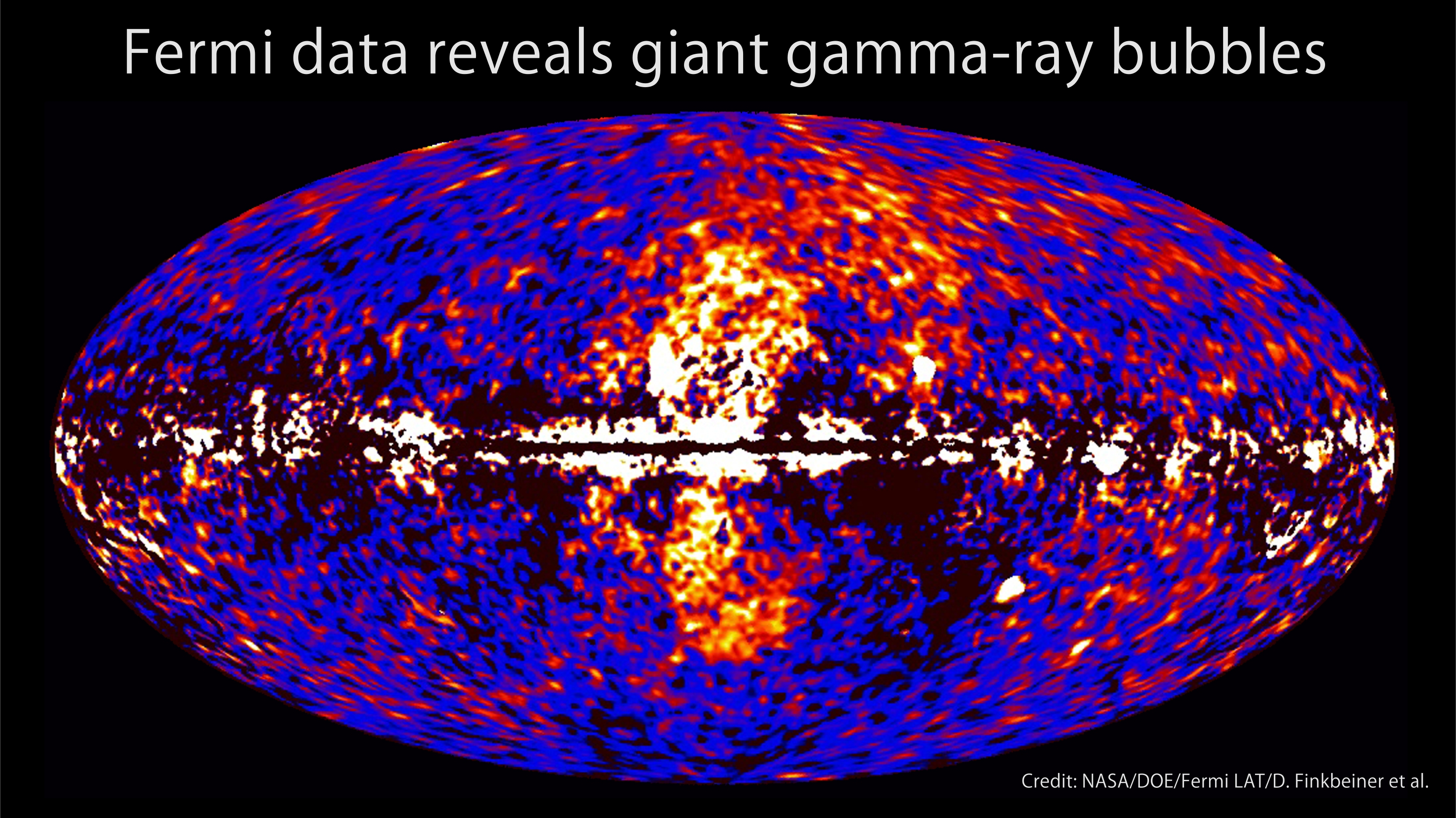
For over a decade, a heated astronomical debate has raged regarding the exact mechanism responsible for generating this galaxy-sized feedback explosion. The first major school of thought points directly at our central supermassive black hole, Sagittarius A* (Sgr A*). This theory suggests that roughly 2 to 6 million years ago, Sgr A* underwent an intense feeding frenzy, violently swallowing thousands of stars' worth of matter. As it gorged on this material, the over-pressurized black hole belched out a pair of highly directed, bipolar relativistic plasma jets along the galaxy's rotation axis, carving out the massive cavities we observe today. Recent computational models simulating successive Tidal Disruption Events (TDEs)—where stars are ripped apart one by one—strongly support this active black hole past.
An alternative, competing theory attributes the bubbles to a massive "nuclear starburst" event. Proponents argue that an intense, localized period of rapid star formation near the galactic center culminated in thousands of coordinated, near-simultaneous supernova explosions. This rapid succession of stellar deaths could have combined into a ferocious collective galactic wind, forcing hot gas out of the disk and into the halo. Whether driven by a ravenous black hole or an explosive surge of newborn stars, the Fermi Bubbles serve as an invaluable, up-close laboratory. They allow scientists to study highly energetic feedback mechanisms that actively dictate how gas, heavy elements, and magnetic fields are recycled through a galaxy.
The long-term significance of the Fermi Bubbles stretches far beyond our local neighborhood. Because we live inside the Milky Way, we have a literal front-row seat to view the intricate physics of galactic outflows, which are usually seen only as faint, blurry shapes in ultra-distant galaxies. These massive energy plumes act as evolutionary thermostats for galaxies; by expelling star-making gas out into the distant halo, such eruptions can effectively slow down or halt a galaxy's future star production altogether, fundamentally steering its structural destiny. Understanding the bubbles helps astronomers decipher the lifecycle of spiral systems across the universe.
Ultimately, the discovery of the Fermi Bubbles is a humbling reminder of how much remains unseen in our cosmic backyard. They demonstrate that a seemingly tranquil stellar system can hide scars of immense, ancient violence right in plain sight. As next-generation telescopes collect clearer deep-space data, tracking the evolution of these monumental gamma-ray structures will keep pushing human physics to its outer limits, shedding light on the hidden, turbulent heart of our home galaxy.