Living on the Moon and Mars
For the entirety of recorded history, the cradle of human civilization has been bound to a single, fragile planet. However, we are currently living through the dawn of an interplanetary renaissance that will permanently alter the trajectory of our species. Driven by rapid advancements in reusable rocketry, autonomous manufacturing, and closed-loop life support systems, humanity is actively preparing to take its monumental next step into the cosmos. Living on the Moon and Mars is no longer a distant luxury reserved for speculative science fiction; it has become an existential imperative and a tangible technological roadmap. As we establish our first permanent footholds on these alien worlds, we will be forced to reinvent our architecture, our technology, and the very structure of human society to survive the harsh realities of deep space.
The immediate stepping stone in this grand migration is the Moon, our closest celestial neighbor. Acting as a vital testing ground located just three days away from Earth, lunar colonization presents unique environmental hurdles. Lacking a protective atmosphere and a substantial magnetic field, the lunar surface is constantly bombarded by cosmic radiation and solar flares, while experiencing brutal 14-day cycles of extreme heat and freezing darkness. To survive, our first lunar outposts will not be fragile glass domes, but heavily shielded structures built inside ancient lava tubes or buried beneath thick layers of lunar soil. By deploying autonomous rovers equipped with 3D-printing extruders, engineers will sinter lunar regolith into solid, radiation-resistant concrete shells, creating modular habitats capable of sustaining long-term human research crews.
The economic and logistical viability of living on the Moon relies entirely on a concept known as In-Situ Resource Utilization (ISRU)—the practice of living off the land. Deep inside the permanently shadowed craters of the lunar south pole lie vast, untouched reserves of water ice. This ice is far more than a source of drinking water; by using solar power to split water molecules into hydrogen and oxygen, colonists can manufacture liquid rocket propellant directly on the lunar surface. Because the Moon’s surface gravity is only one-sixth of Earth's, launching spacecraft from the lunar surface requires a fraction of the energy. The Moon will effectively transform into a cosmic refueling station and industrial launchpad, serving as the critical gateway that propels humanity toward the rest of the solar system.
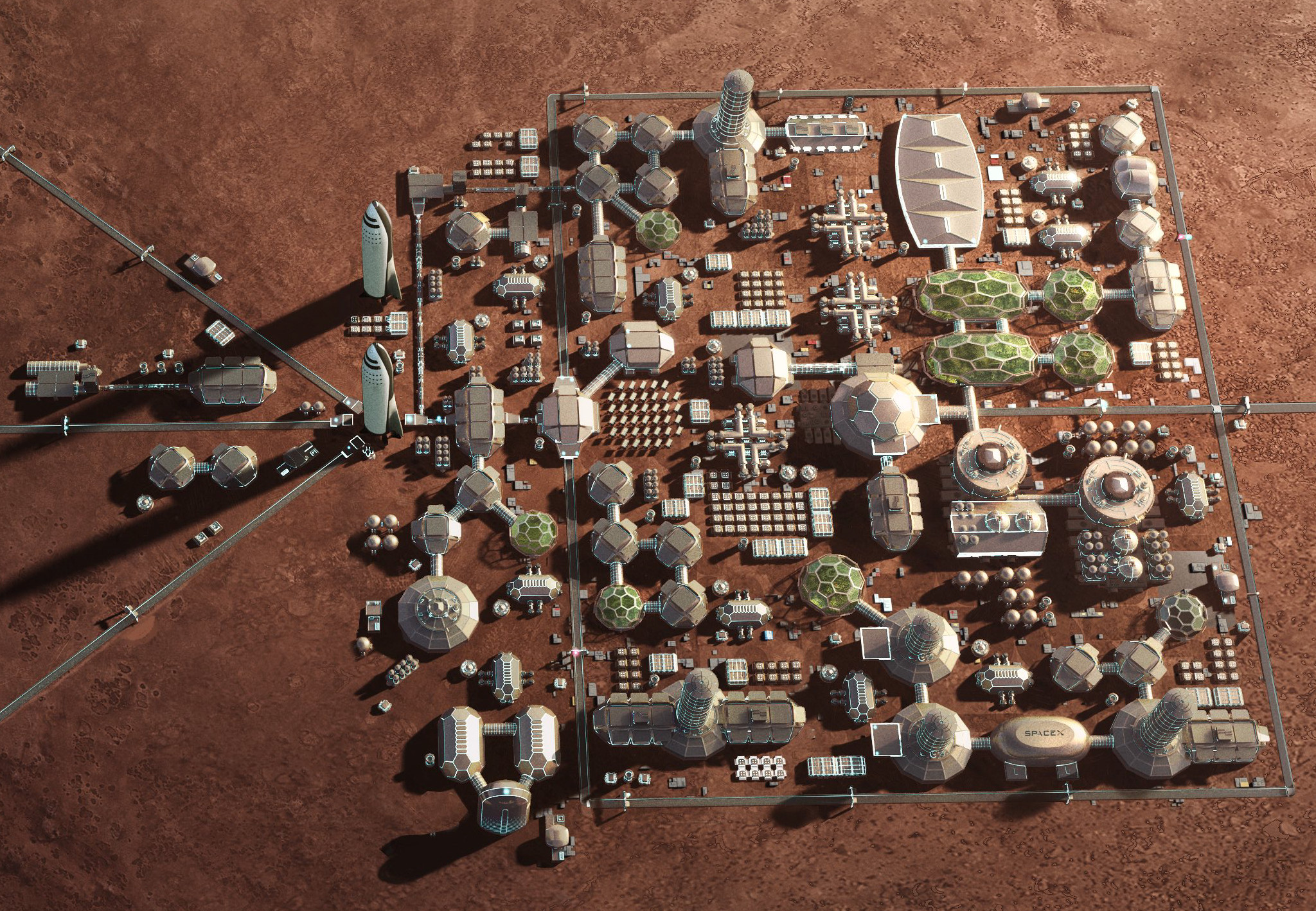
While the Moon serves as our local laboratory, Mars represents the ultimate destination for an independent, self-sustaining multi-planetary civilization. Located months away across a dark orbital void, the Red Planet offers a starkly different and profoundly haunting environment. Mars possesses a thin, unbreathable carbon dioxide atmosphere, a gravity profile roughly 38% of Earth's, and an endless expanse of iron-oxide desert swept by planet-wide dust storms. Despite these hostile conditions, Mars holds all the raw ingredients required to sustain life. Its frozen polar ice caps and vast subsurface glaciers hold abundant water, while its soil contains the vital minerals needed to kickstart automated, pressurized hydroponic greenhouses, allowing future Martian citizens to grow their own food independently of Earth.
Building a functioning society on Mars will require a complete overhaul of our relationship with resource consumption. On Earth, we have long operated on a linear economy of extraction and waste; on Mars, any waste is a fatal design flaw. Martian cities will be the most advanced circular economies ever conceived. Every drop of moisture, every breath of exhaled carbon dioxide, and every scrap of organic waste must be meticulously captured, processed, and recycled through highly complex environmental control loops. Energy production will rely on massive arrays of advanced solar panels paired with compact, safe nuclear fission reactors to ensure a continuous power supply during prolonged global dust storms, driving the heavy machinery needed to extract methane fuel from the Martian atmosphere.
Beyond the immense engineering achievements, the transition to becoming a multi-planetary species will trigger a profound psychological and cultural evolution. Future generations born on the Red Planet—true Martians—will grow up under a pale blue sun, viewing Earth not as a home, but as a distant, historical cradle glowing in the night sky. The physical realities of lower gravity will subtly alter human physiology over generations, lengthening spines and changing bone density profiles. Culturally, the absolute interdependence required to maintain an artificial ecosystem will foster deeply collaborative, highly organized, and scientifically rigorous societies, giving rise to entirely novel legal frameworks, philosophical perspectives, and artistic movements born out of the frontier of space.
Ultimately, establishing permanent civilizations on the Moon and Mars is about securing the long-term survival of human consciousness. By distributing our species across multiple worlds, we insulate our collective knowledge, culture, and achievements against catastrophic planetary risks. The journey to the stars will undoubtedly test the absolute limits of human endurance, intellect, and resolve. Yet, as our robotic pioneers pave the way and our first courageous colonists seal their airlocks on these distant shores, we will finally transition from being mere passengers on an isolated island to becoming true citizens of the cosmos, embarking on the greatest chapter of exploration in human history.