Our Solar System
Bound together by the immutable law of gravity, our solar system is a vast, dazzling dynamic neighborhood nestled within the Orion Cygnus arm of the Milky Way galaxy. Formed approximately 4.6 billion years ago from the gravitational collapse of a giant interstellar molecular cloud, it has evolved into a highly complex structure of worlds orbiting a singular central anchor. At its absolute heart sits the Sun—a colossal, blazing yellow dwarf star (G-type main-sequence star) that accounts for an astonishing 99.86% of the entire system's mass. The Sun acts as the ultimate powerhouse, generating an immense magnetic field and casting out the radiant light, heat, and solar winds that dictate the atmospheric conditions, weather cycles, and potential for life across every celestial body in its dominion.
Orbiting this radiant center are eight primary planets, which astronomers categorize into two fundamentally different structural realms: the tightly packed, rocky inner planets, and the colossal, fluid worlds of the outer system. The inner solar system is home to the terrestrial planets, defined by their solid surfaces, silicate rock composition, and metallic cores. Closest to the solar fire is Mercury, a heavily cratered, airless world locked in a brutal cycle of temperature extremes, swinging from a scorching 430°C during the day to a freezing -180°C at night. Beyond it lies Venus, often called Earth's twin due to its similar size, yet masked by a runaway greenhouse effect. Its suffocatingly thick atmosphere of carbon dioxide and clouds of sulfuric acid trap solar heat so effectively that its surface remains a constant, melting 475°C, making it the hottest planet in the system.
The third rock from the Sun is Earth, our vibrant blue oasis and the only known world in the entire cosmos confirmed to harbor life. It is uniquely blessed with a protective magnetosphere, an oxygen-rich atmosphere, and vast oceans of liquid water that cover 71% of its surface. Neighboring Earth is Mars, the rust-colored "Red Planet." Mars is a frigid, desert world blanketed in iron oxide dust, yet it boasts geological features of mythical proportions. It is home to Olympus Mons, the largest known volcano in the solar system—standing three times higher than Mount Everest—as well as ancient, dried-up river valleys and frozen polar caps that hint at a warmer, wetter, and potentially habitable past.
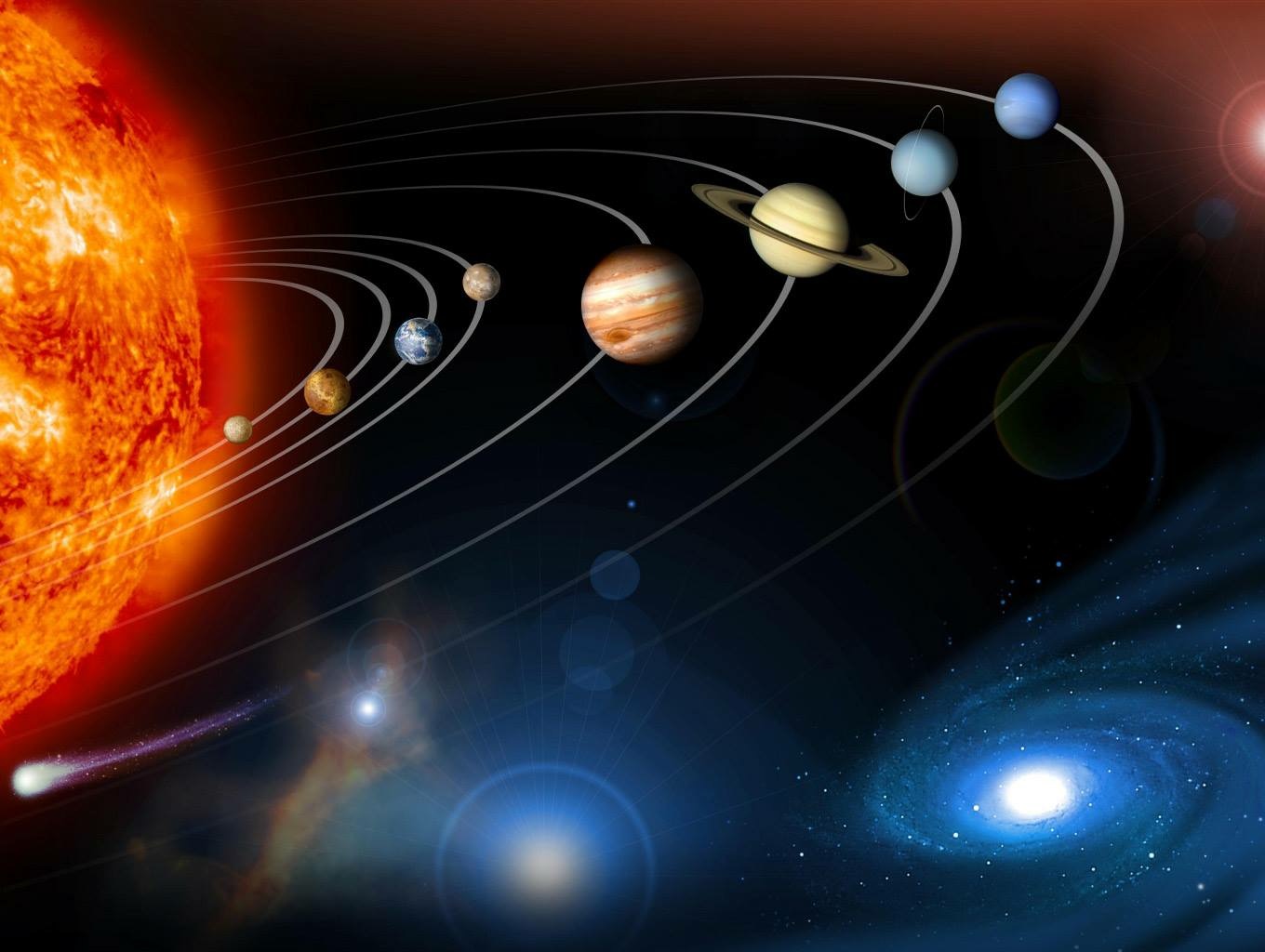
Crossing the vast celestial threshold of the inner system requires passing through the Asteroid Belt—a sprawling ring containing millions of rocky fragments and remnants left over from the dawn of planet formation, including the dwarf planet Ceres. Past this debris field lies the realm of the outer giants, worlds of incomprehensible scale composed almost entirely of gases and ices. First among them is Jupiter, a planetary king so massive that it contains more than twice the mass of all the other planets combined. Jupiter is a swirling sphere of hydrogen and helium, famous for its colorful atmospheric bands and the Great Red Spot—a monstrous, counter-clockwise hurricane wider than Earth itself that has raged for centuries. Jupiter also acts as a mini-solar system, governing a massive armada of moons, including icy Europa, which hides a global liquid ocean beneath its frozen crust.
Next is Saturn, the jewel of our night sky. While structurally similar to Jupiter, Saturn is universally renowned for its spectacular, sprawling ring system. These highly reflective rings span up to 282,000 kilometers wide but are incredibly thin—averaging just 10 meters in thickness—and are composed of billions of individual particles of water ice, rocky debris, and cosmic dust. Following Saturn are the twin ice giants, Uranus and Neptune, which differ from the gas giants due to higher concentrations of water, ammonia, and methane ices in their mantles. Uranus stands out for its pale cyan hue and its radical, rule-breaking tilt; it rotates completely on its side, likely due to a cataclysmic collision with an Earth-sized object long ago. Its twin, Neptune, is a deep-blue, wind-whipped world. Driven by internal heat, Neptune experiences the most violent weather in the solar system, with supersonic winds whipping through its methane atmosphere at speeds exceeding 2,100 kilometers per hour.
Our cosmic neighborhood does not end at the orbit of Neptune. Beyond the dark, freezing outermost planetary boundary lies the Kuiper Belt, a vast ring of icy bodies and primordial relics. This dark frontier is the home of several recognized dwarf planets—most famously Pluto, which was reclassified from a primary planet in 2006, sparking global scientific debate—as well as Makemake, Haumea, and Eris. Millions of frozen comets originate here and in the even more distant, hypothetical Oort Cloud, occasionally plunging inward toward the Sun, trailing brilliant tails of vaporized gas and dust across our night skies.
As a whole, our solar system is a beautifully synchronized machine, but it is far from stationary. The entire system hurtsles through the dark void of interstellar space at an astonishing speed of roughly 515,000 miles per hour (828,000 km/h) as it tracks a massive, sweeping orbit around the supermassive black hole at the center of the Milky Way galaxy—a cosmic journey that takes roughly 230 million years to complete just once. While humanity has pushed the boundaries of exploration by sending robotic pioneers like NASA's Voyager 1 and Voyager 2 probes out past the heliosphere and into interstellar space, our local neighborhood remains a tapestry of unsolved mysteries, holding deep secrets about the origin of water, the evolution of atmospheres, and the cosmic ingredients required to spark life.