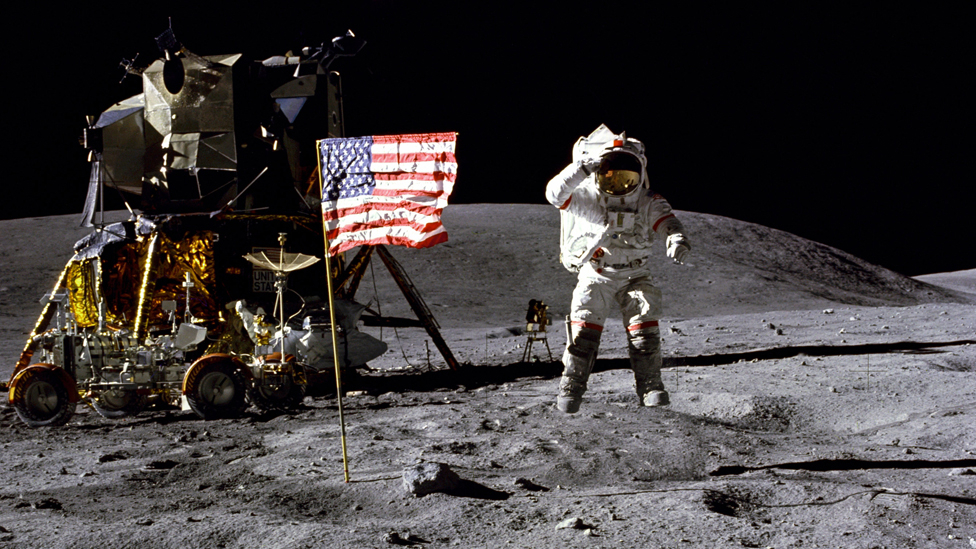
Apollo 11 Lands on the Moon
On July 20, 1969, the world held its breath as NASA’s Apollo 11 mission achieved what was once thought impossible: humans walking on the moon. Launched from Kennedy Space Center aboard the colossal Saturn V rocket, astronauts Neil Armstrong, Buzz Aldrin, and Michael Collins embarked on a journey that symbolized the pinnacle of human ingenuity. After a four-day voyage, the lunar module Eagle descended to the Sea of Tranquility, and Armstrong’s iconic words—“That’s one small step for man, one giant leap for mankind”—marked the moment humanity stepped onto another world. Aldrin joined him, planting the American flag and collecting samples, while Collins orbited above in the command module Columbia. Watched by over 600 million people via live television, this event wasn’t just a scientific feat; it was a bold declaration of human potential, born from President Kennedy’s 1961 vow to reach the moon within the decade, amidst fierce competition with the Soviet Union in the Space Race.
The broader impact of Apollo 11 stretched far beyond that historic day, reshaping technology, geopolitics, and society. The mission demanded innovations like advanced computers, lightweight materials, and precision engineering—breakthroughs that later fueled the tech boom, from personal computers to satellite communications. Politically, it was a Cold War coup for the United States, showcasing democratic innovation over Soviet rivalry and boosting national pride at a time of domestic unrest. Over 400,000 people—engineers, scientists, and workers—united for this cause, proving the power of collective effort. Culturally, it transformed humanity’s self-image; photos like “Earthrise” revealed our planet’s fragility, igniting environmental awareness. Economically, it seeded the space industry, now a multi-billion-dollar field encompassing everything from GPS to space tourism. Yet, it also provoked critique—some questioned the cost when Earth faced poverty and war. Apollo 11’s triumph was a paradox: a unifying achievement that also exposed our divisions, a moment of glory that asked us to look both outward and inward.
In today’s context, Apollo 11 remains a beacon of ambition and a challenge for the future. As private companies like SpaceX and nations like China pursue lunar bases and Mars missions, it prompts reflection: how do we channel such audacity responsibly? The moon landing’s legacy isn’t just in the footprints left behind but in the questions it raises about exploration’s purpose. It united the world in awe, yet today’s fragmented societies and climate crises demand a new kind of unity—one that balances cosmic dreams with terrestrial care. It’s a reminder that our greatest leaps come not from technology alone but from shared vision and resolve. In 1969, it was a race to the moon; now, it’s a call to explore with wisdom, ensuring our next steps honor both the heavens and the home we’ve glimpsed from afar.