Formation of Earth
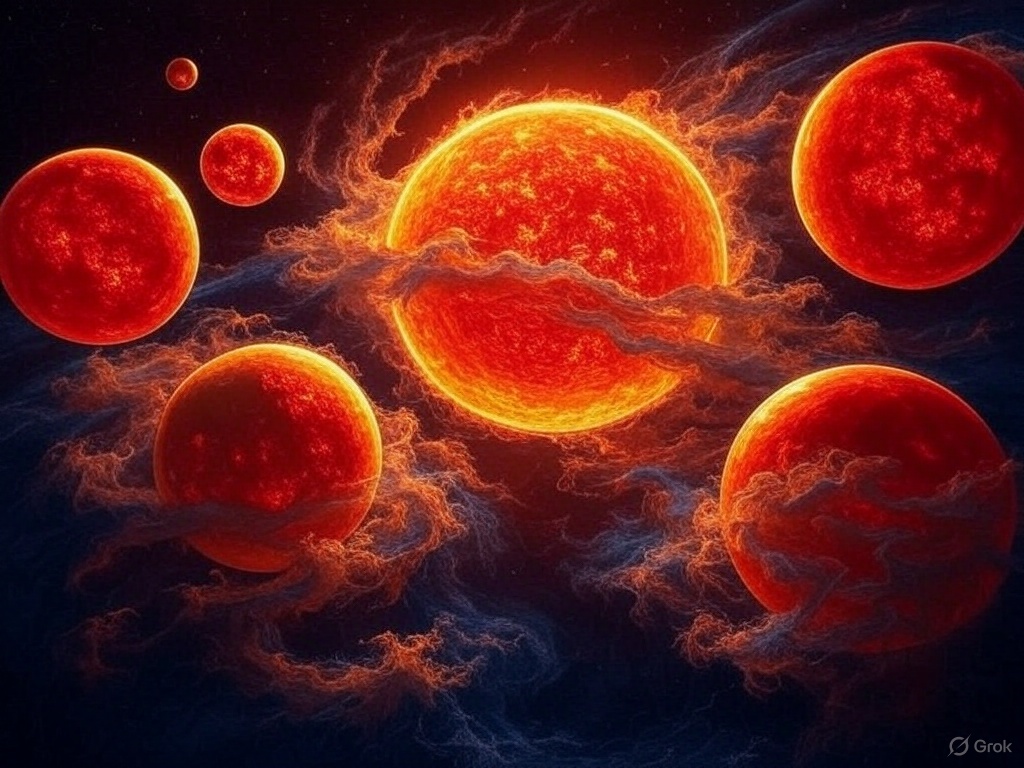
Earth formed around 4.54 billion years ago within the Sun’s protoplanetary disk, a rotating cloud of gas and dust. Small particles collided and stuck together, forming planetesimals that grew through accretion into a protoplanet. Over millions of years, gravitational attraction caused these bodies to merge, creating a molten Earth. This early planet was bombarded by asteroids and comets, contributing to its mass and delivering water and organic compounds. The intense heat from collisions and radioactive decay melted the planet, allowing heavier elements to sink and form its core.
As Earth cooled, a solid crust began to form, while volcanic activity released gases that created a primitive atmosphere rich in carbon dioxide and nitrogen. The planet’s magnetic field emerged as the iron-nickel core differentiated into a solid inner core and liquid outer core, protecting the atmosphere from solar wind. The late heavy bombardment, a period of intense meteorite impacts around 4 billion years ago, reshaped the surface and may have delivered additional water. These processes established Earth as a rocky planet with the potential to support liquid water and, eventually, life.
The formation of Earth is studied through ancient rocks, meteorites, and planetary science missions. Zircon crystals from Western Australia, dating back 4.4 billion years, provide evidence of early crust formation. Missions like NASA’s MAVEN and ESA’s Rosetta offer insights into planetary formation processes by studying Mars and comets. Earth’s unique position in the habitable zone and its geological activity set the stage for life’s emergence. Ongoing research into exoplanets and Earth’s early conditions continues to refine our understanding of how our planet became a cradle for life.