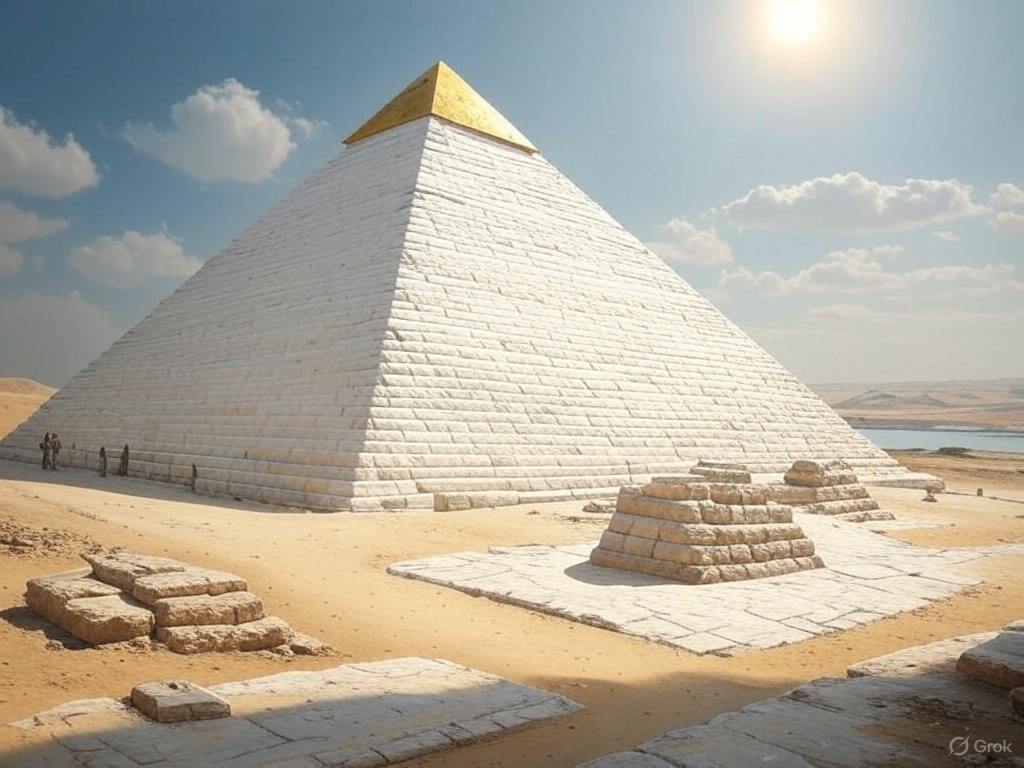
King Khufu Completes the Great Pyramid of Giza
In 2560 BCE, King Khufu, the second pharaoh of Egypt’s Fourth Dynasty, oversaw the completion of the Great Pyramid of Giza, an architectural marvel that remains one of humanity’s most enduring achievements. Standing at 481 feet, it held the title of the world’s tallest man-made structure for over 3,800 years, a testament to the ingenuity and organizational prowess of ancient Egyptian society. Constructed as Khufu’s tomb, the pyramid required the quarrying, transportation, and precise placement of approximately 2.3 million limestone blocks, each weighing between 2 and 15 tons. Scholars estimate that this monumental task took about 20 years, reflecting not only engineering skill but also the ability to sustain a massive workforce over decades. The pyramid’s near-perfect alignment with the cardinal directions and its complex internal chambers—including the King’s Chamber with its granite sarcophagus—demonstrate an advanced understanding of mathematics, astronomy, and construction techniques.
The logistics of building the Great Pyramid were staggering. Contrary to earlier myths of slave labor, modern evidence suggests that a workforce of 20,000 to 30,000 skilled laborers, farmers during the off-season, and support staff were involved. These workers lived in purpose-built villages near the site, complete with bakeries, breweries, and medical facilities, indicating a well-organized society capable of mobilizing resources on an unprecedented scale. Techniques such as ramps, levers, and possibly counterweights were employed to hoist the massive stones into place, though the exact methods remain a subject of scholarly debate. The pyramid’s completion marked the zenith of Egypt’s Old Kingdom pyramid-building era, symbolizing Khufu’s divine authority and the state’s economic and political stability. It also set the stage for the Giza plateau’s development, later joined by the pyramids of Khufu’s successors, Khafre and Menkaure, and the enigmatic Great Sphinx.
The Great Pyramid’s legacy extends far beyond its time. Designated a UNESCO World Heritage site, it attracts millions of visitors annually, each drawn to its sheer scale and the mysteries it holds—such as the purpose of its air shafts or the precision of its construction. For contemporary audiences, it serves as a powerful reminder of what humans can achieve with determination, collaboration, and rudimentary tools. It bridges us to an ancient civilization that, despite its distance in time, shared our ambition to create something eternal. The pyramid challenges us to consider our own potential: what monuments might we build today, and what will they say about us to future generations?